Monday, January 7, 2008

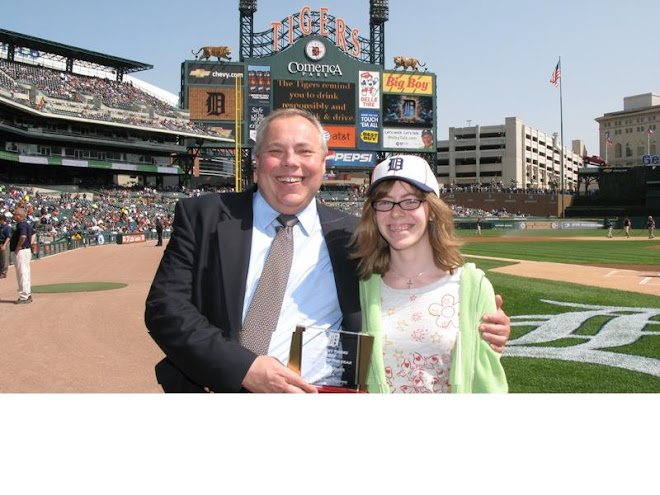
Father of the Week

I know I should be watching the BCS Championship game, Ohio State's getting an ass-kicking of historic proportions and all; and I know I should be paying attention to the weather since we've got a Tornado Watch in effect here on a January 7 which, unbelievably, saw the temperature hit the mid-60's, but on this evening this is more important.  You see, The Lauroo was today named "Student of the Week" at Power Middle School (PMS).

When so informed of this most momentous development after school today, first by her and subsequently in a personal phone call from none other than the principal himself,  my reaction was what anyone who knows me--especially Laura,  would  expect it to be.  I said to her,  "What does this mean to The Dad?"

In mere moments though it occurred to me exactly what this meant to me and as soon as I came to that realization my face brightened. Beaming, I looked at Laura and exclaimed, "This makes me The Father of the Week!"

Laura found this disconcerting, asking, "What did you do, exactly?"

"Well," I said, "Quite literally for starters as far as you are concerned, I had sex with your mother."

"What else?"

"I'm sure I'll think of something."

I kid, of course.  She knows I was kidding, too, so don't worry about that and don't think bad thoughts about me.  Not any worse than the thoughts you usually think, anyway.  The fact is that I could not have been prouder.  Actually, the fact is that I could not be prouder of her whether she's "Student of the Week" or not.  While my bias is as obvious as is the reason for it, I'm her father for crying out loud, I can tell you that I have never once had to worry about this one, save for the day she was born.  And even then she was thoughtful enough to see to it that I only had to worry for half a day.

Laura was born early--a preemie.  She weighed in six weeks early.   Almost seven, in fact.  This, as you might imagine,  took Jeannie and me completely by surprise.  We were very decidedly not yet ready for a baby.  Hell, we still had two sessions left  in our "So You're About To Be Parents For the First Time" class, the last of which involved a tour of the nursery and birthing areas of Beaumont Hospital. 

What happened was that the baby doctor told us to proceed directly to Beaumont after examining Jeannie during a regularly scheduled visit when we still thought we had a month-and-a-half left to prepare for the arrival of our baby.  She had developed a condition and, unless labor could be induced, they were going to have to go and get the baby straightaway.

Now, that worried me. 

We spent the rest of the day in a hospital room waiting to see if those inducing drugs would in fact induce, having been told that if the baby wasn't born that night, a C-section would have to be performed first thing the next morning.

Early in the evening, one of those birthing classes we still needed to take to complete our parenting course came through the delivery area and I told Jeannie that with nothing better to do I may as well join them and off I went.  The last stop was the nursery.  I stood there looking at all those brand new babies and I had no emotion whatsoever and it scared me to death.  I knew for a fact that I had a baby just like the ones I was looking at coming into my life the very next day and those babies in the nursery did nothing for me.  Nothing at all.  Was this how I was going to feel the next day?  My blood ran cold.  I was worried I'd made a huge mistake.  Having a baby had been my idea, after all.  I knew Jeannie had her worries, too.  She'd ask me from time to time, "What if we don't like having a baby?  It's not like we can give it back, you know!"

Other than making her feel like crap, the inducing drugs had no effect on Jeannie and the next morning they took her in for her emergency C-section, leaving me to wait  in the hallway.  I spent what seemed like the longest time sitting there in my scrubs contemplating what I felt was the distinct  possibility that I could lose my wife and my baby in one fell swoop if things weren't going right in that operating room. 

Finally, the nurse came to take me into the operating theatre, which I am pretty sure was an afterthought.  I think they forgot about me, because by the time they came to get me the doctors were well along in the procedure.  When I walked in and glanced over at my wife I saw what looked to me like a huge incision.  I remember thinking, "My God, they are cutting her in half!"  I'll never forget the speed with which the surgeon worked.  I swear you could hear the knives clanking against one another.  Honest to God, the closest thing I'd ever seen to it  involved a spectacle I'd taken in one night at a restaurant in Peoria where a professional hockey player I knew cut up and ate a 60-ounce steak in under eleven minutes.  Fast, man. 

And so, within a minute of my sitting down next to Jeannie, they pulled Laura out.  The surgeon held her aloft, like he was hoisting the Stanley Cup it seemed to me, and announced that we had a baby girl.  The baby girl had what appeared to me to be a look of shocked surprise on her face.  As in, "Just what in the hell do you people think you are doing?"  And, "What's a people, anyway?  I have no idea, you know.  I've never seen one before."  It was 11:04 in the morning and my life had changed forever.

Jeannie's reaction surprised me.  "A daughter?  I have a daughter?"  I could tell she was happier than she would have been had we had a son.  Which, by the way, is what we had been convinced we were going to have.  For my part, I was surprised that I didn't seem to care if it was a boy or a girl.  I was just happy, more than happy, with the baby we had.  I mean, instantly happy. 

A nurse took the baby off to the side and I could tell things weren't perfect.  They were working her over pretty good.  They let me hold her for about five seconds and show her to her mother and before she even got a decent look at her baby girl they'd snatched her right back from me and went right back to working on her.

"She's a little blueish," one of the nurses said.  "She's not getting  enough air."  They give all newborns something called an APGAR test.  I can't remember if that's an acronym or not, nor can I remember on what criteria they test the baby.  I can't remember Laura's APGAR score but I remember asking and I remember being concerned when I was told that the number, which was on the scale of one-to-ten, was lower than the number should have been based on what we had learned in the Learning To Be A Parent class and the pre-birth reading and research I had done.  Besides, truth be told, the baby did look a little on the purple side to me even if I didn't want to admit it.

Within a moments I found myself walking alongside a little gurney which was taking Laura off to Baby Intensive Care.  They'd put a little tiny oxygen mask on her little tiny face.  It looked like it was squishing her tiny little left eye.  I felt bad for her (I don't think I thought of her as my daughter yet, not enough time had elapsed for that mental adjustment to take place) and asked the nurse to readjust the mask but she said it was the best they could do given her size.  Laura had indeed weighed in, but she didn't weigh in much:  only four pounds, two ounces.  There was just not a lot of baby there. 

They popped her into an incubator and I watched her sleep for a while and then went off in search of my wife.  She was in post-op on a different floor drugged to the brink of incoherency and when I walked in I looked at her and I said, (and this is a direct quote): "OHMYGOD!SHE"SSOBEAUTIFULshelooksjustlikeyou!and shehasthecutestlittlehandsthatlookjustlikeyourhandsand            theprettiestlittleeyesthatlookjustlikeyoureyesanddidImentionshe'sjustBEAUTIFULandarewestillgoingtonameherLauraanddidItell youthat'sshe'sjustBEAUTIFUL?"

Jeannie looked up at me like she had just learned that her husband was from freaking Mars.  I didn't know at the time, but all I had done was convince her that something was terribly, terribly wrong with her baby daughter.  She'd had, after all, never seen me in such a state.  She'd never heard me talk so fast and mind you, I announced professional hockey games for a living and as such was trained to talk fast.  But never, ever as fast as I was banging on then. 

I left her and went off to find her mother in the waiting room.  There were about ten people there and when I spotted her I told her, "You have a granddaughter!" and everybody else in the room burst into applause and you should have seen the look on Edith's face!

Then the oddest thing.  I knew one of the people in the room.  He was a PR guy for one of the teams I covered and I was still all excited and I started to tell him how great it was and how happy he was going to be and he had to stop me to tell me that he and his wife were there because their baby had died in the womb and they were there to have it removed and I just felt so bad and I just had no idea what to say. 

There was one other odd thing. We lived only a couple of miles from the hospital, making it easy to run home on errands.  I had gone to the house for something and when I was getting in the car to go back to the hospital for some reason, probably having something to do with the fact that I was pretty goofy that day, I left my wallet on the roof of the car as I drove off.  That evening I got a call from a reporter at WWJ which was strange because I was working at WJR, a competing station.  We were colleagues.  He didn't want a quote for the news about our newborn, he wanted to tell me that he had found my wallet lying on Coolige Road.  What are the odds on something like that?

Blissfully unaware my wallet was missing, I got back to the hospital around four o'clock, just in time for them to take the baby out of the incubator.  I looked down at her and she was all pink and perfect  and I just knew that that kid was as healthy as a horse.  There was no doubt in my mind.  I stopped worrying right then and there.  Like I said, half a day, that's all I  had to worry about my Laura.  It's all I've ever had to worry about her.  A nurse started to put an IV needle in her little forehead. I asked why.  She told me it was for antibiotics.  I told the nurse she didn't need them, that she was perfectly healthy.  The nurse didn't much seem to care about my opinion for some reason and so Laura spent the first few days of her life with that needle stuck in her head.  It's okay.  She doesn't remember.

Over the course of the next few days I would pick her up and hold her tiny little self in my arms all the time and I would softly sing to her: "She's just a little woo baby girl, living in her little woo baby world.  And she's doing little woo baby things..."  I sang that song I'd made up on the spot to her over and over and over.  I always thought additional verses would come to me, but they never did.  And they never have. Not to this day.  And I'm going to stop now because the memories are making me cry, I love her so much.

Except for this one little memory.  Before one could enter that special care nursery where Laura spent the first ten days of her life, it was mandatory to wash your hands using a special soap and a special little scrubbing sponge with hard plastic bristles which were provided by the hospital.  I was fanatical about it.  If I saw somebody try to go into the nursery and I didn't think they'd spent the full 8 or 10 minutes washing, whichever the sign said was the required time to spend at the task, I'd call 'em on it and make 'em go back and wash their hands some more.  I didn't care. 

A day or so after Laura was born our pastor drove all the way over from Farmington to visit us at  the hospital.  I was sitting in a chair in the nursery rocking Laura (singing the Woo Baby song, no doubt) when I looked up and there he was.  Before I even knew what the words were that were coming out of my mouth, I demanded of him, "Did you wash your hands?"

Like I said, I'm Father of the Week. 

Friday, January 4, 2008

Dreams

Did you ever see "The Lonely Guy"?  It's not the best comedy ever, but it does have its moments.  Such as when Steve Martin tells Charles Grodin that he's going to go take a nap and Grodin responds by saying he doesn't like to nap.

"You know that feeling you have when you wake up and realize who you are?"  he asks.  "I only like to have to go through that once a day."

My love of and appreciation for a good nap non-withstanding, I find myself approaching a similar line of reasoning.

There was the day before yesterday, for example, when what Grodin described became my literal experience as I awoke from a wonderful dream, the best I'd had in months.  I was working, doing a stand-up, a live shot, from the Super Bowl.  Sadly, with consciousness came  my reality, that being that I was not in fact at the Super Bowl and that it was just  another day of my not working: another day with no show for me to do, no live shot to perform on-site at a sporting event.  No nothing.  It actually took me a few minutes to get over it.   To quote from another movie, in this case the classic Airplane, "What a pisser!"

Then there was last night and a dream which I must consider to be, at the very least, unsettling.  I was at a baseball game.  Because I recognized the players' uniforms, I'm pretty sure I was at the Big A watching the Los Angeles Angels of Anaheim or whatever in the hell they are calling themselves these days play the Detroit Tigers.  In the bottom of the 8th one of the Halos clobbered a homer with one out and two aboard to erase what had been a 3-2 Detroit lead. The Tiger pitcher must have hung one because he flat-out hit the snot out of the thing.  Way back into the seats in left.  The thing is, as the hitter made his way around the bases I couldn't help but notice that the batter-runner was, in fact, a dog.  A dog who bore an uncanny resemblance to a beagle I'd seen earlier in the day in a TV ad.  It must have been, now that I think of it, a three-dog homer!  The little guy was so excited that when he rounded third, bounding in the air and barking with the sheer delight of the moment, he ran past the dog ahead of him, failing to heed my shouts of, "Don't do it!"  He realized his mistake and fell back behind the dog who had been in front of him, but I don't have to tell you that it was already too late.  He was, of course, out for passing a teammate on the basepaths.  Then the lead dog, the one who had occupied first when the homer was hit, turned around and scampered back to be with his buddy the homer-hitter. He  was also declared out for violation of the same rule.  The dog in the middle simply turned and trotted into the dugout without touching home plate although that faux paws didn't matter so much since the inning was by now all over.  The Tigers went on to win.

Moments later, I found myself being excoriated for all of this by Angels manager Mike Scioscia.  He was livid, screaming at me while making  generous use of every bad word known to  Organized Ball while all the while managing to maintain flawless grammar.

I have no idea what to make of any of this.  I wonder what tonight will bring.  Unless I take a nap before then, and in spite of it all, I'm not at all ruling that out at this point in time.

Tuesday, July 17, 2007

Flashbacks of a lost cause

Here's an interesting discussion of history from The Boston Globe today which, if one shares the view of the writer (and I do), has a bearing on the situation in Iraq.  It's about the occupation of Palestine by the British.  You can read a lot of thoughtful stories like this on at a site I check just about every day, True Blue Liberal.  The address is http://www.trueblueliberal.com/

As for the Boston Globe piece...

http://www.boston.com/news/globe/editorial_opinion/oped/articles/2007/07/17/flashbacks_of_a_lost_cause/

By H.D.S. Greenway  |  July 17, 2007

AT FIRST the template was Germany and Japan in 1945. As we turned those defeated tyrannies into successful democracies, so would we create a new Iraq, and by so doing transform the entire Middle East. Now we are told that Korea might provide an example for a long-term America presence.

As Washington struggles with what to do with a lost war, consider the British experience in Palestine and their 30-year mandate after World War I. The British entered Palestine believing that they were liberating the land from Ottoman tyranny. Britain, "with its technological and military superiority . . . its entrepreneurial and missionary zeal, its largely democratic institutions, was to take the once-great peoples of the East into tutelage and direct their slow but sure progress under stable and just government," A.J. Sherman recalls in his book, "Mandate Days." "This clashed almost immediately with the reality of Palestine."

Although favoring a Jewish homeland under the Balfour Declaration, the British genuinely hoped for national reconciliation and peace in Palestine between Jews and Arabs. But from the beginning the soldiers found themselves in a dilemma because, as Tom Segev writes in "One Palestine Complete," "the government expected the army to impose peace between the Jews and the Arabs, as a result of which it had to fight both of them."

At first the British "reflected indefatigable optimism," Segev writes, and were slow to realize that they were in the middle of a civil war in which neither side would compromise. Both sides were "wedded to their national identity and committed to victory."

First came the Arab revolt of 1936-1939, which was marked by cruelty and torture of Arab prisoners -- including simulated drowning. Later on, even before the end of World War II, came terror from the Zionist side. When Arabs and Jews weren't fighting each other they attacked the British, who were still trying to create space for national reconciliation.

Casualties mounted as the British tried troop surges to get on top of deteriorating security. An additional 25,000 soldiers sent to Palestine became the biggest troop deployment sent overseas between the two world wars.

The British were blown up in terrorist attacks, their soldiers kidnapped and killed. When they weren't surging, they holed up in Green Zone-like enclaves called "Bevingads," after Foreign Minister Ernest Bevin.

After World War II, support for the mandate quickly eroded. Winston Churchill complained about this "squalid warfare with terrorists."

"Security continued to erode despite the presence of over 100,000 troops," Sherman writes. "The sense of constant menace (was) heightened by the ubiquitous roadside mines, against which no British vehicle could be adequately armored."

Toward the end, Chief Secretary William Battershill wrote that the British were staying because "they just did not know how to pull out," according to Segev. Bevin admitted to David Ben-Gurion, who would become Israel's first prime minister, that "Palestine is not vital to England, but England does not want to have to admit failure."

Both Arabs and Jews were ready and anxious to have the British stay on as long as a British presence could further their cause. But once the British seemed to be favoring one side, trouble came from the other.

A principle reason for staying on was fear of the chaos that would follow a retreat. But after 30 years of trying to engineer compromise, the British left with their tails between their legs when support on the home front collapsed. Once they were gone, the feared upsurge of bloodshed between Arabs and Jews was realized, and the nightmare of outside intervention from neighboring states came to pass. The ramifications are with us still.

Ben-Gurion had predicted it all in 1919. "Everyone sees the problem in relations between the Jews and the Arabs," he said. "But not everyone sees that there's no solution to it . . . The conflict between the interests of the Jews and the interests of the Arabs in Palestine cannot be resolved by sophisms . . . I don't know of any Arabs who would agree to Palestine being ours . . . We want the country to be ours. The Arabs want the country to be theirs." In the end, Ben-Gurion was willing to divide the land. The Arabs were not.

There may be little comparison between the two national movements who fought the British and each other over Palestine and the contentious groups struggling for power in Iraq today. But the danger of a foreign power fighting a long war to force compromise on combatants who have no interest in compromise is hauntingly similar.

H.D.S. Greenway's column appears regularly in the Globe.

© Copyright 2007 Globe Newspaper Company.

Friday, July 13, 2007

While Europeans Holiday, Americans Toil

http://www.truthdig.com/report/item/20070709_while_europeans_holiday_americans_toil/


Posted on Jul 9, 2007

By Marie Cocco

If you’re reading this while on vacation, great for you. If you’re reading this at work, having just finished a vacation or a five-day weekend cobbled together around last week’s celebration of Independence Day, I hope the time off was as spectacular as the fireworks.

If you won’t get another day off work until December’s holiday season, you’re not alone. Americans and vacations just don’t mix.

This may surprise those who have just spent hours stranded at airports or idling in a hot line for a ride at an amusement park. But a quarter of American workers get no paid vacation or paid holidays. And on average, those private-sector workers who do get paid time off are granted only nine vacation days and six paid holidays each year, according to government statistics analyzed by the Center for Economic and Policy Research.

The liberal-leaning think tank analyzed paid vacation and holiday leave policies among the U.S. and nations with comparably developed economies—the European Union, Canada, Japan, Australia and New Zealand.  The predictable portrait is one of the United States as a nation of workaholics—a syndrome related less to the archetype of a striving executive than it is linked to government policy.

In the rest of the industrialized world, a month or more of paid vacation is typical, and often required. Many Americans know that. And there are can-you-top-this supplements to this surfeit of paid time off. Such as: In Austria, workers who labor at “heavy night work” get two or three extra days off. Also in Austria—as well as in Sweden and New Zealand—workers are actually paid at a higher rate when they’re on vacation than when they’re at work.

In France, workers get extra paid time off if they take some of their vacation days outside of the summer season. In Norway, those 60 and older get extra time off. And of course, your vacation could be ruined if you get sick while you’re away. So Sweden guarantees that if a worker becomes sick while on leave, the days of the illness don’t count against vacation time.

Stingy leave policies in the United States go hand and hand with weekly work hours that exceed those in many industrialized countries. And they parallel skimpy sick leave and family leave policies that give millions of Americans no effective safety net when illness or emergencies strike. Nearly half of private-sector workers—57 million people—have no paid sick days, according to Rep. Rosa DeLauro, D-Conn., a chief sponsor of a measure to require at least some sick days for employees who work more than 30 hours per week. The problem is particularly acute for low-wage workers, more than three-fourths of whom get no paid leave when they are ill.

In theory, all this hard work is supposed to spark a more robust economy that is, in turn, an engine of greater upward mobility than what is found in the supposedly coddled precincts of, say, the European Union. But lately, it hasn’t. An ongoing, bipartisan study of intergenerational economic mobility conducted jointly by conservative and liberal-leaning researchers for the Pew Charitable Trusts has found the myth of superior American mobility to be—a myth.

Researchers for the Economic Mobility Project studied the relationship of adult children’s incomes to those of their parents and found that the United States now lags behind France, Germany, Sweden, Canada, Finland, Norway and Denmark in this measure of upward mobility. “There is little available evidence that the United States has more relative mobility than other advanced nations,” the group reported in May. “If anything, the data seem to suggest the opposite.”

Comparing the incomes of American men who were in their 30s in 2004 with males who were in their 30s in 1974, the researchers found that today’s men actually earn about 12 percent less, after inflation, than their fathers’ generation did. “There has been no progress at all for the youngest generation,” the group reported. The American family stays afloat because its total income has been swelled by women’s paychecks.

The sober statistics should lead toward saner economic policies. Europe, Canada and the rest of the industrialized world are doing just fine with guaranteed health insurance, pensions, maternity leave and sick time—not to mention a month at the beach. Here at home, nothing threatens the American dream so much as political disinclination to cast off old thinking and demand change for new and harsher economic times. 

Wednesday, July 11, 2007

What's the Biggest Story of the Day?

Tuesday, July 10, 2007


This is just what I've heard on the radio today.  It's like this pretty much everyday.  What I will do is jot down a brief notation about these items I find to be important off the top of my head every day for a week or so and we'll see where we stand...

Everybody on McCain Staff Quits or is Fired:

I'm not sure if it was firings or resignations this time around, but after 50 campaign staffers were "cut loose" last week, John McCain's campaign manager and all top staff today announced they were leaving the campaign, too...The suggestion is being floated that McCain may drop out of the presidential race by the weekend. It's that bad.  How long ago was it that McCain was the favorite to win the '08 GOP nomination? 

LA Senator (R-Naturally) Named Client by DC Madam:

I'll have to look the guys name up on "ThinkProgress" or "Huffington Post, but it's true.  One of Louisiana's two United States Senators has released a statement to the Associated Press expressing regret for "the harm he's done to his family, etc." after it became known or was about to become known that his name was the "DC Madam's" address book. 

The story is that Senator got a call from "Hustler Magazine" (did "Hustler" publisher Larry Flynt buy that address book?  I may have read that he had).

Within hours of the call from the magazine, Senator's office released a statement in which he expressed regret the way you want to see it expressed, not merely "profound" but "profound" and "heartfelt".   The phrases "years ago" and "I asked for the forgiveness of God and my wife" were prominently used. 

Here's the best part: this guy got into congress when he replaced a congressman (Livingston?) who had been forced to resign when his extra-marital affair had been made public by "Hustler" publisher Larry Flynt.  He just looked like too big a hypocrite.  Whining about Clinton's dalliance by day, banging a whore by night.  It was all so, You know, unseemly.

Here's the second-best part:  on "The Stephanie Miller show this morning, they read a quote from the John's wife you had to like.  Back in the 90's, during her husband's first term in the house (where he spent plenty of time on the record calling for Clinton to quit over a, well-you-know, the wife gets asked if she would be as forgiving of her husband as Mrs. Clinton had been of Prsident Clinton.  She  said something along the lines of how she'd be more like Lorena Bobbitt.  Lornea Bobbitt got in the news a number of years ago (but they never leat you forget, do they Lorena?) by cutting off her cheating husband's, you know.  Ouch.  I saw the procedure called a "bobbittectomy" on a post at the popular "Jesus' General web site. 

Iraq "Oh-For" in Benchmark-Meeting

The troublesome mainstream media reports today that when President Bush reports to congress Sunday on the situation in Iraq he will reveal that the Iraqi government has achieved exactly none of the benchmarks by which their progress of lack thereof is being measured.  The report was mandated by congress as part of a previously-approved  Iraq spending bill.

Former Surgeon General Decries Political Meddling

The former Surgeon General of the US testified congress that political considerations routinely won out over public health policy considerations during his four-year tenure as the nations top doc. 

Bush Blames Al-Queda for Iraq Violence

In a speech in Cleveland the president said, "the crowd (oh, that crowd) who are attacking us there is the same crowd that attacked us on 9-11." 

And With All That Going On...

The lead story on the ABC Evening News on Monday the 1oth and the lead story on all three of the morning shows on Tuesday the 11th was none of the above. 

Chertoff, the head of the Department of Homeland Security, told a Chicago newspaper that he had a "gut feeling" that there could be a significant terrorist event on US soil this summer, noting that terrorist are "active" during the summer months.  He said, apparently missing that the point he was making is that the current administration has done nothing, no thing, to make us safer in the last 6 years, "We are at as great a risk of attack today as we were on Sept. 10, 2001."


Wednesday, July 11, 2007

Again, this is just what I've heard on the radio or seen on the internet today: 

New Orleans Hooker says Louisiana Senator Was Customer

Same Senator who was busted  yesterday, just to update that another call girl, this one in the home district New Orleans, says the GOP Senator was a regular john there, too.

I have got to get this guys name.  Stephanie Miller, on Guess the Quote today, read a long list of 1990's quotes from this twit when he was a congressman calling for Clinton to resign the presidency because he had cheated on his wife.  Hi again, everybody. 

Rachael Maddow cited five instances where hookers and the repubs have had brushed up against one another, so to speak.  Let's see, there was Jeff Gannon/Guckert, the White House "reporter" and gay escort who, if the Visitors Log is accurate, may have had numerous sleep-overs at the White House itself;  The Fabulously Revered Ted Haggert who was president of the largest evangelical Christian organization in America, busted for drugs and hanging with a male prostitute; the State Department official previously disclosed to have been a "client" of the DC prostitute, and I can't remember the others although Dusty Foggo's name came up in connection with the defense contractor scandal which resulted in the conviction of San Diego congressman Duke Cunningham because there was some whoring around going on there, too. 

I Don't Recall

A former aide to Karl Rove testified before the US Senate today regarding the US Attorney resignations, but in the main couldn't remember anything of significance about her days in the White House.  The Bush White House had demanded that the woman not testify, but there she was today so I'm not sure what the deal was. 


Tuesday, July 10, 2007

How a Lie Becomes the Truth

There's a lot of truth in this article from way back in 2000 on how it came to be that Al Gore was tagged with the "I invented the Internet" line and how it cost him the presidency.   It serves not just as a part of the historical record, but of what we must not let happen again going forward.


http://www.consortiumnews.com/2000/020100a.html


Al Gore v. the Media

By Robert Parry

To read the major newspapers and to watch the TV pundit shows, one can't avoid the impression that many in the national press corps have decided that Vice President Al Gore is unfit to be elected the next president of the United States.

Across the board -- from The Washington Post to The Washington Times, from The New York Times to the New York Post, from NBC's cable networks to the traveling campaign press corps -- journalists don't even bother to disguise their contempt for Gore anymore.

At one early Democratic debate, a gathering of about 300 reporters in a nearby press room hissed and hooted at Gore's answers. Meanwhile, every perceived Gore misstep, including his choice of clothing, is treated as a new excuse to put him on a psychiatrist's couch and find him wanting.

Journalists freely call him "delusional," "a liar" and "Zelig." Yet, to back up these sweeping denunciations, the media has relied on a series of distorted quotes and tendentious interpretations of his words, at times following scripts written by the national Republican leadership.

In December, for instance, the news media generated dozens of stories about Gore's supposed claim that he discovered the Love Canal toxic waste dump. "I was the one that started it all," he was quoted as saying. This "gaffe" then was used to recycle other situations in which Gore allegedly exaggerated his role or, as some writers put it, told "bold-faced lies."

But behind these examples of Gore's "lies" was some very sloppy journalism. The Love Canal flap started when The Washington Post and The New York Times misquoted Gore on a key point and cropped out the context of another sentence to give readers a false impression of what he meant.

The error was then exploited by national Republicans and amplified endlessly by the rest of the news media, even after the Post and Times grudgingly filed corrections.

Almost as remarkable, though, is how the two newspapers finally agreed to run corrections. They were effectively shamed into doing so by high school students in New Hampshire and by an Internet site called The Daily Howler, edited by a stand-up comic named Bob Somerby. [http://www.dailyhowler.com/]

Though the major media often portrays the Internet as a bastion for crazed conspiracy theories, the nation's prestige newspapers appeared to have sunk into their own pattern of reckless journalism.

The Love Canal quote controversy began on Nov. 30 when Gore was speaking to a group of high school students in Concord, N.H. He was exhorting the students to reject cynicism and to recognize that individual citizens can effect important changes.

As an example, he cited a high school girl from Toone, Tenn., a town that had experienced problems with toxic waste. She brought the issue to the attention of Gore's congressional office in the late 1970s.

"I called for a congressional investigation and a hearing," Gore told the students. "I looked around the country for other sites like that. I found a little place in upstate New York called Love Canal. Had the first hearing on that issue, and Toone, Tennessee -- that was the one that you didn't hear of. But that was the one that started it all."

After the hearings, Gore said, "we passed a major national law to clean up hazardous dump sites. And we had new efforts to stop the practices that ended up poisoning water around the country. We've still got work to do. But we made a huge difference. And it all happened because one high school student got involved."

The context of Gore's comment was clear. What sparked his interest in the toxic-waste issue was the situation in Toone -- "that was the one that you didn't hear of. But that was the one that started it all."

After learning about the Toone situation, Gore looked for other examples and "found" a similar case at Love Canal. He was not claiming to have been the first one to discover Love Canal, which already had been evacuated. He simply needed other case studies for the hearings.

The next day, The Washington Post stripped Gore's comments of their context and gave them a negative twist. "Gore boasted about his efforts in Congress 20 years ago to publicize the dangers of toxic waste," the Post reported. "'I found a little place in upstate New York called Love Canal,' he said, referring to the Niagara homes evacuated in August 1978 because of chemical contamination. 'I had the first hearing on this issue.' … Gore said his efforts made a lasting impact. 'I was the one that started it all,' he said." [WP, Dec. 1, 1999]

The New York Times ran a slightly less contentious story with the same false quote: "I was the one that started it all."

The Republican National Committee spotted Gore's alleged boast and was quick to fax around its own take. "Al Gore is simply unbelievable -- in the most literal sense of that term," declared Republican National Committee Chairman Jim Nicholson. "It's a pattern of phoniness -- and it would be funny if it weren't also a little scary."

The GOP release then doctored Gore's quote a bit more. After all, it would be grammatically incorrect to have said, "I was the one that started it all." So, the Republican handout fixed Gore's grammar to say, "I was the one who started it all."

In just one day, the key quote had transformed from "that was the one that started it all" to "I was the one that started it all" to "I was the one who started it all."

Instead of taking the offensive against these misquotes, Gore tried to head off the controversy by clarifying his meaning and apologizing if anyone got the wrong impression. But the fun was just beginning.

The national pundit shows quickly picked up the story of Gore's new exaggeration.

"Let's talk about the 'love' factor here," chortled Chris Matthews of CNBC's Hardball. "Here's the guy who said he was the character Ryan O'Neal was based on in ‘Love Story.’ … It seems to me … he's now the guy who created the Love Canal [case]. I mean, isn't this getting ridiculous? … Isn't it getting to be delusionary?"

Matthews turned to his baffled guest, Lois Gibbs, the Love Canal resident who is widely credited with bringing the issue to public attention. She sounded confused about why Gore would claim credit for discovering Love Canal, but defended Gore's hard work on the issue.

"I actually think he's done a great job," Gibbs said. "I mean, he really did work, when nobody else was working, on trying to define what the hazards were in this country and how to clean it up and helping with the Superfund and other legislation." [CNBC's Hardball, Dec. 1, 1999]

The next morning, Post political writer Ceci Connolly highlighted Gore's boast and placed it in his alleged pattern of falsehoods. "Add Love Canal to the list of verbal missteps by Vice President Gore," she wrote. "The man who mistakenly claimed to have inspired the movie 'Love Story' and to have invented the Internet says he didn't quite mean to say he discovered a toxic waste site." [WP, Dec. 2, 1999]

That night, CNBC's Hardball returned to Gore's Love Canal quote by playing the actual clip but altering the context by starting Gore's comments with the words, "I found a little town…"

"It reminds me of Snoopy thinking he's the Red Baron," laughed Chris Matthews. "I mean how did he get this idea? Now you've seen Al Gore in action. I know you didn't know that he was the prototype for Ryan O'Neal's character in ‘Love Story’ or that he invented the Internet. He now is the guy who discovered Love Canal."

Matthews compared the vice president to "Zelig," the Woody Allen character whose face appeared at an unlikely procession of historic events. "What is it, the Zelig guy who keeps saying, 'I was the main character in ‘Love Story.’ I invented the Internet. I invented Love Canal."

Former secretary of labor Robert Reich, who favors Gore's rival, former Sen. Bill Bradley, added, "I don't know why he feels that he has to exaggerate and make some of this stuff up."

The following day, Rupert Murdoch's New York Post elaborated on Gore's pathology of deception. "Again, Al Gore has told a whopper," the Post wrote. "Again, he's been caught red-handed and again, he has been left sputtering and apologizing. This time, he falsely took credit for breaking the Love Canal story. … Yep, another Al Gore bold-faced lie."

The editorial continued: "Al Gore appears to have as much difficulty telling the truth as his boss, Bill Clinton. But Gore's lies are not just false, they're outrageously, stupidly false. It's so easy to determine that he's lying, you have to wonder if he wants to be found out.

"Does he enjoy the embarrassment? Is he hell-bent on destroying his own campaign? … Of course, if Al Gore is determined to turn himself into a national laughingstock, who are we to stand in his way?"

On ABC's "This Week" pundit show, there was head-shaking amazement about Gore's supposed Love Canal lie.

"Gore, again, revealed his Pinocchio problem," declared former Clinton adviser George Stephanopoulos. "Says he was the model for 'Love Story,' created the Internet. And this time, he sort of discovered Love Canal."

A bemused Cokie Roberts chimed in, "Isn't he saying that he really discovered Love Canal when he had hearings on it after people had been evacuated?"

"Yeah," added Bill Kristol, editor of Murdoch's Weekly Standard. Kristol then read Gore's supposed quote: "I found a little place in upstate New York called Love Canal. I was the one that started it all." [ABC’s This Week, Dec. 5, 1999]

The Love Canal controversy soon moved beyond the Washington-New York power axis.

On Dec. 6, The Buffalo News ran an editorial entitled, "Al Gore in Fantasyland," that echoed the words of RNC chief Nicholson. It stated, "Never mind that he didn't invent the Internet, serve as the model for 'Love Story' or blow the whistle on Love Canal. All of this would be funny if it weren't so disturbing."

The next day, the right-wing Washington Times judged Gore crazy. "The real question is how to react to Mr. Gore's increasingly bizarre utterings," the Times wrote. "Webster's New World Dictionary defines 'delusional' thusly: 'The apparent perception, in a nervous or mental disorder, of some thing external that is actually not present … a belief in something that is contrary to fact or reality, resulting from deception, misconception, or a mental disorder.'"

The editorial denounced Gore as "a politician who not only manufactures gross, obvious lies about himself and his achievements but appears to actually believe these confabulations."

But The Washington Times' own credibility was shaky. For its editorial attack on Gore, the newspaper not only printed the bogus quote, "I was the one that started it all," but attributed the quote to The Associated Press, which had actually quoted Gore correctly, ("That was the one...").

The Washington Times' challenge to Gore's sanity also was reminiscent of its 1988 publication of false rumors that Democratic presidential nominee Michael Dukakis had undergone psychiatric treatment. [As for the Times' insinuations about Gore's "delusional" behavior, it might be noted that the newspaper's founder and financial backer, South Korean theocrat Sun Myung Moon, considers himself the Messiah.]

Yet, while the national media was excoriating Gore, the Concord students were learning more than they had expected about how media and politics work in modern America.

For days, the students pressed for a correction from The Washington Post and The New York Times. But the prestige papers balked, insisting that the error was insignificant.

"The part that bugs me is the way they nit pick," said Tara Baker, a Concord High junior. "[But] they should at least get it right." [AP, Dec. 14, 1999]

When the David Letterman show made Love Canal the jumping off point for a joke list: "Top 10 Achievements Claimed by Al Gore," the students responded with a press release entitled "Top 10 Reasons Why Many Concord High Students Feel Betrayed by Some of the Media Coverage of Al Gore's Visit to Their School." [Boston Globe, Dec. 26, 1999]

The Web site, The Daily Howler, also was hectoring what it termed a "grumbling editor" at the Post to correct the error.

Finally, on Dec. 7, a week after Gore's comment, the Post published a partial correction, tucked away as the last item in a corrections box. But the Post still misled readers about what Gore actually said.

The Post correction read: "In fact, Gore said, 'That was the one that started it all,' referring to the congressional hearings on the subject that he called."

The revision fit with the Post's insistence that the two quotes meant pretty much the same thing, but again, the newspaper was distorting Gore's clear intent by attaching "that" to the wrong antecedent. From the full quote, it's obvious the "that" refers to the Toone toxic waste case, not to Gore's hearings.

Three days later, The New York Times followed suit with a correction of its own, but again without fully explaining Gore's position. "They fixed how they misquoted him, but they didn't tell the whole story," commented Lindsey Roy, another Concord High junior.

While the students voiced disillusionment, the two reporters involved showed no remorse for their mistake. "I really do think that the whole thing has been blown out of proportion," said Katharine Seelye of the Times. "It was one word."

The Post's Ceci Connolly even defended her inaccurate rendition of Gore's quote as something of a journalistic duty. "We have an obligation to our readers to alert them [that] this [Gore's false boasting] continues to be something of a habit," she said. [AP, Dec. 14, 1999]

The half-hearted corrections also did not stop newspapers around the country from continuing to use the bogus quote.

A Dec. 9 editorial in the Lancaster [Pa.] New Era even published the polished misquote that the Republican National Committee had stuck in a press release: "I was the one who started it all."

The New Era then went on to psychoanalyze Gore. "Maybe the lying is a symptom of a more deeply-rooted problem: Al Gore doesn't know who he is," the editorial stated. "The vice president is a serial prevaricator."

In the Milwaukee Journal Sentinel, writer Michael Ruby concluded that "the Gore of '99" was full of lies. He "suddenly discovers elastic properties in the truth," Ruby declared. "He invents the Internet, inspires the fictional hero of 'Love Story,' blows the whistle on Love Canal. Except he didn't really do any of those things." [Dec. 12, 1999]

The National Journal's Stuart Taylor Jr. cited the Love Canal case as proof that President Clinton was a kind of political toxic waste contaminant. The problem was "the Clintonization of Al Gore, who increasingly apes his boss in fictionalizing his life story and mangling the truth for political gain. Gore -- self-described inspiration for the novel Love Story, discoverer of Love Canal, co-creator of the Internet," Taylor wrote. [National Journal, Dec. 18, 1999]

On Dec. 19, GOP chairman Nicholson was back on the offensive. Far from apologizing for the RNC's misquotes, Nicholson was reprising the allegations of Gore's falsehoods that had been repeated so often that they had taken on the color of truth: "Remember, too, that this is the same guy who says he invented the Internet, inspired Love Story and discovered Love Canal."

More than two weeks after the Post correction, the bogus quote was still spreading. The Providence Journal lashed out at Gore in an editorial that reminded readers that Gore had said about Love Canal, "I was the one that started it all." The editorial then turned to the bigger picture:

"This is the third time in the last few months that Mr. Gore has made a categorical assertion that is -- well, untrue. … There is an audacity about Mr. Gore's howlers that is stunning. … Perhaps it is time to wonder what it is that impels Vice President Gore to make such preposterous claims, time and again." [Providence Journal, Dec. 23, 1999]

On New Year's Eve, a column in The Washington Times returned again to the theme of Gore's pathological lies.

Entitled "Liar, Liar; Gore's Pants on Fire," the column by Jackie Mason and Raoul Felder concluded that "when Al Gore lies, it's without any apparent reason. Mr. Gore had already established his credits on environmental issues, for better or worse, and had even been anointed 'Mr. Ozone.' So why did he have to tell students in Concord, New Hampshire, ‘I found a little place in upstate New York called Love Canal. I had the first hearing on the issue. I was the one that started it all.'" [WT, Dec. 31, 1999]

The characterization of Gore as a clumsy liar continued into the new year. Again in The Washington Times, R. Emmett Tyrrell Jr. put Gore's falsehoods in the context of a sinister strategy:

"Deposit so many deceits and falsehoods on the public record that the public and the press simply lose interest in the truth. This, the Democrats thought, was the method behind Mr. Gore's many brilliantly conceived little lies. Except that Mr. Gore's lies are not brilliantly conceived. In fact, they are stupid. He gets caught every time … Just last month, Mr. Gore got caught claiming … to have been the whistle-blower for 'discovering Love Canal.'" [WT, Jan. 7, 2000]

It was unclear where Tyrrell got the quote, "discovering Love Canal," since not even the false quotes had put those words in Gore's mouth. But Tyrrell's description of what he perceived as Gore's strategy of flooding the public debate with "deceits and falsehoods" might fit better with what the news media and the Republicans had been doing to Gore.

Beyond Love Canal, the other prime examples of Gore's "lies" -- inspiring the male lead in Love Story and working to create the Internet -- also stemmed from a quarrelsome reading of his words, followed by exaggeration and ridicule rather than a fair assessment of how his comments and the truth matched up.

The earliest of these Gore "lies," dating back to 1997, was Gore's expressed belief that he and his wife Tipper had served as models for the lead characters in the sentimental bestseller and movie, Love Story.

When the author, Erich Segal, was asked about Gore's impression, he stated that the preppy hockey-playing male lead, Oliver Barrett IV, indeed was modeled after Gore and Gore's Harvard roommate, actor Tommy Lee Jones. But Segal said the female lead, Jenny, was not modeled after Tipper Gore. [NYT, Dec. 14, 1997]

Rather than treating this distinction as a minor point of legitimate confusion, the news media concluded that Gore had willfully lied. The media made the case an indictment against Gore’s honesty.

In doing so, however, the media repeatedly misstated the facts, insisting that Segal had denied that Gore was the model for the lead male character. In reality, Segal had confirmed that Gore was, at least partly, the inspiration for the character, Barrett, played by Ryan O'Neal.

Some journalists seemed to understand the nuance but still could not resist denigrating Gore's honesty.

For instance, in its attack on Gore over the Love Canal quote, the Boston Herald conceded that Gore "did provide material" for Segal's book, but the newspaper added that it was "for a minor character." [Boston Herald, Dec. 5, 1999] That, of course, was untrue, since the Barrett character was one of Love Story's two principal characters

The media's treatment of the Internet comment followed a similar course. Gore's statement may have been poorly phrased, but its intent was clear: he was trying to say that he worked in Congress to help develop the Internet. Gore wasn’t claiming to have "invented" the Internet or to have been the "father of the Internet," as many journalists have asserted.

Gore's actual comment, in an interview with CNN's Wolf Blitzer that aired on March 9, 1999, was as follows: "During my service in the United States Congress, I took the initiative in creating the Internet."

Republicans quickly went to work on Gore's statement. In press releases, they noted that the precursor of the Internet, called ARPANET, existed in 1971, a half dozen years before Gore entered Congress. But ARPANET was a tiny networking of about 30 universities, a far cry from today's "information superhighway," ironically a phrase widely credited to Gore.

As the media clamor arose about Gore's supposed claim that he had invented the Internet, Gore's spokesman Chris Lehane tried to explain. He noted that Gore "was the leader in Congress on the connections between data transmission and computing power, what we call information technology. And those efforts helped to create the Internet that we know today." [AP, March 11, 1999]

There was no disputing Lehane's description of Gore's lead congressional role in developing today's Internet. But the media was off and running.

Routinely, the reporters lopped off the introductory clause "during my service in the United States Congress" or simply jumped to word substitutions, asserting that Gore claimed that he "invented" the Internet which carried the notion of a hands-on computer engineer.

Whatever imprecision may have existed in Gore's original comment, it paled beside the distortions of what Gore clearly meant. While excoriating Gore's phrasing as an exaggeration, the media engaged in its own exaggeration.

Yet, faced with the national media putting a hostile cast on his Internet statement -- that he was willfully lying -- Gore chose again to express his regret at his choice of words.

Now, with the Love Canal controversy, this media pattern of distortion has returned with a vengeance. The national news media has put a false quote into Gore's mouth and then extrapolated from it to the point of questioning his sanity. Even after the quote was acknowledged to be wrong, the words continued to be repeated, again becoming part of Gore's record.

From the media’s hostile tone, one might conclude that reporters have reached a collective decision that Gore should be disqualified from the campaign.

At times, the media has jettisoned any pretext of objectivity. According to various accounts of the first Democratic debate in Hanover, N.H., reporters openly mocked Gore as they sat in a nearby press room and watched the debate on television.

Several journalists later described the incident, but without overt criticism of their colleagues. As The Daily Howler observed, Time's Eric Pooley cited the reporters' reaction only to underscore how Gore was failing in his "frenzied attempt to connect."

"The ache was unmistakable -- and even touching -- but the 300 media types watching in the press room at Dartmouth were, to use the appropriate technical term, totally grossed out by it," Pooley wrote. "Whenever Gore came on too strong, the room erupted in a collective jeer, like a gang of 15-year-old Heathers cutting down some hapless nerd."

Hotline's Howard Mortman described the same behavior as the reporters "groaned, laughed and howled" at Gore's comments.

Later, during an appearance on C-SPAN's Washington Journal, Salon's Jake Tapper cited the Hanover incident, too. "I can tell you that the only media bias I have detected in terms of a group media bias was, at the first debate between Bill Bradley and Al Gore, there was hissing for Gore in the media room up at Dartmouth College. The reporters were hissing Gore, and that's the only time I've ever heard the press room boo or hiss any candidate of any party at any event." [See The Daily Howler, http://www.dailyhowler.com/, Dec. 14, 1999]

Traditionally, journalists pride themselves in maintaining deadpan expressions in such public settings, at most chuckling at a comment or raising an eyebrow, but never demonstrating derision for a public figure.

Reasons for this widespread media contempt for Gore vary. Conservative outlets, such as Rev. Moon's Washington Times and Murdoch's media empire, clearly want to ensure the election of a Republican conservative to the White House. They are always eager to advance that cause.

In the mainstream press, many reporters may feel that savaging Gore protects them from the "liberal" label that can so damage a reporter's career. Others simply might be venting residual anger over President Clinton's survival of the Monica Lewinsky scandal. They might believe that Gore's political destruction would be a fitting end to the Clinton administration.

Reporters apparently sense, too, that there is no career danger in showing open hostility toward Clinton's vice president.

Yet, the national media's prejudice against Gore -- now including fabrication of damaging quotes and misrepresentation of his meaning -- raises a troubling question about this year's election and the future health of American democracy:

How can voters have any hope of expressing an informed judgment when the media intervenes to transform one of the principal candidates -- an individual who, by all accounts, is a well-qualified public official and a decent family man -- into a national laughingstock?

What hope does American democracy have when the media can misrepresent a candidate’s words so thoroughly that they become an argument for his mental instability -- and all the candidate feels he can do about the misquotes is to apologize?

As The Daily Howler's Somerby observes, the concern about deception and its corrosive effect on democracy dates back to the ancient Greeks.

"Democracy won't work, the great Socrates cried, because sophists will create mass confusion," Somerby recalled at his Web site. "Here in our exciting, much-hyped new millennium, the Great Greek's vision remains crystal clear." [The Daily Howler, Jan. 13, 2000] 


The Libby Pardon Explained

http://www.truthout.org/docs_2006/070607A.shtml


Bush's Real Fourth of July Message to Nation: Unprintable
    By Elizabeth de la Vega
    t r u t h o u t | Guest Contributor

    Friday 06 July 2007

 Knowing I could not listen to President Bush's actual voice on what is supposed to be a fun holiday, I turned to the White House web site to find his Fourth of July greeting. We continue to be, the president assures us, steadfastly committed to "America's founding truths" - including, of course, liberty and equality. I think it was the word "equality" that caused me to start choking on my corn on the cob.

    Maybe there was some mistake. This web site posting did not even come close to reflecting the president's real Fourth of July message to the nation. That had been quite effectively delivered earlier in the week when Bush announced he was commuting I. Lewis "Scooter" Libby's sentence from thirty months to zero months. Apparently confusing his duties as president of the United States with those of a behind-the-plate umpire, President Bush called Libby's sentence "excessive" and threw the prison time out, as casually as if he were calling balls and strikes in a game of sandlot baseball. In so doing, President Bush sent a message to the American people that is as unambiguous as it is unprintable. Expressed verbally, the real message Bush was sending to the people of the United States could have been sent with just two words (the second of which is "you"); expressed physically, Bush's underlying message could have been conveyed with just one finger.

    Either way, President Bush has again made it as clear as a Wisconsin lake that he has nothing but contempt for equality and the "rule 'a law" he is so fond of championing. Yes, a president has the constitutional power of clemency. He may pardon a criminal defendant, thereby wiping out the entire conviction and its consequences, or commute the sentence, thereby lessening it to some degree or entirely. But even this power, broad as it is, can be abused and, in the case of United States v. Libby, President Bush has done just that.

    Just how egregious was the president's unapologetic and cavalier act of favoritism for a wealthy and powerful friend? To ask the question is to answer it, but to fully appreciate the extent of corruption inherent in the president's recent shameless exercise of noblesse sans oblige, one needs to know a bit about Bush and the Federal Sentencing Guidelines.

    In the spirit of full disclosure, let me say that I, along with many others who have worked in the federal criminal justice system, have never been a fan of the sentencing guidelines. Formulated by a commission that was, in turn, created by the Sentencing Reform Act of 1984, the guidelines were specifically intended to promote fairness and remove unwarranted sentencing disparities. In practice, however, particularly in drug cases, application of the guidelines has led to draconian sentences - an inequity that federal judges, prosecutors and defense attorneys have attempted to address by applying various factors that could justify a downward departure from the prescribed range.

    But, up until July 2, 2007, when he decided to take the law into his own hands, President Bush loved the sentencing guidelines. Bush and the Republicans have, for years, been insisting that the guidelines be applied rigidly - the president was simply not going to have any of this unseemly leniency that was beginning to infect the federal system under his watch. Indeed, in 2003, during the very same period that Bush, Cheney, Libby and the gang were scrambling to squelch the ever-increasing revelations about the president's fraudulent case for war, Bush's Justice Department, then under the leadership of John Ashcroft - and a posse of conservative Republican members of Congress - decided to take on these wimpy judges and make sure that neither they, nor any equally wimpy prosecutors, could exercise any discretion whatsoever with regard to sentencing. Tom DeLay told judges, "We are watching you" and the Bush administration tacked onto a child pornography law an amendment that required every downward departure from the guidelines to be reported to Congress.

    Not surprisingly, this amendment, called the Feeney Amendment in honor of its titular sponsor, Representative Tom Feeney (R-Florida), caused a huge uproar, but its spirit lives on in the Department of Justice today. Right now, in July of 2007, prosecutors are required to oppose virtually all downward departures from the Federal Sentencing Guidelines, except those based on substantial assistance to the government. If a judge does grant a downward departure that was not sought by the government, the prosecutor has to report that to DoJ's appellate division for consideration of an appeal.

    What does this mean in the context of the Libby case? With due consideration to the high likelihood that some of the people reading this may have had an extra beer or two the day before, I am going to make it very simple:

    Scooter Libby was sentenced in accordance with the sentencing guidelines, to which President Bush has been insisting that prosecutors and judges slavishly adhere ever since he arrived in the White House. The sentencing range required by case law that Bush's own DoJ attorneys have routinely argued for, in cases throughout the country, was 30 to 37 months. Judge Reggie Walton gave Libby the lowest sentence within that range. Legally, the only way the judge could impose a sentence less than 30 months would have been if he had granted Libby's motion for downward departure. Libby had not provided substantial assistance to the government. Therefore, under the rules currently in effect within Bush's Justice Department, Libby had no legitimate ground for downward departure, and Patrick Fitzgerald was required to oppose his motion. If Judge Walton had actually departed downward based on any of these unapproved grounds, Fitzgerald would have been required, per the United States Attorneys' Manual, to report the downward departure so that issue could be evaluated for appeal.

    So, forgive me if I started choking on my blueberry cobbler when I read Tony Snow's July 3 statement to reporters: "The President spent weeks and weeks consulting with senior members of this White House about the proper way to proceed, and they looked at a whole lot of options, and they spent a lot of time talking through the options and doing some very detailed legal analysis." Bush, we know, never spoke to any of the legal experts on the case, including, most notably, the prosecutor - even though Department of Justice clemency procedures call for such a consultation. He may well have spent "weeks and weeks" consulting with Dick Cheney and Karl Rove and their ilk in order to decide how to handle "the Libby issue," but they were only talking about how to sell an act of clemency ... what their talking points would be. Bush's statement betrays not a shred of legal analysis, which is not surprising, since there is none available to justify his decision.

    The bottom line is that Bush's commitment to equality, the rule of law and uniform sentencing under the federal guidelines fizzled like a Fourth of July sparkler when it came to his friend.

    Even more important, Bush, of course, never intended to allow Libby to go to prison at all. Indeed, his original plan was to avoid any investigation whatsoever into the unauthorized disclosure of Valerie Wilson's identity as a CIA agent. The president could have, and should have, begun an internal investigation when Robert Novak's column exposed the existence of the leak on July 14, 2003. He didn't; he waited. Once the investigation was announced in late September 2003, Bush was still constitutionally required to ferret out the miscreants in his shop, but he did not do so. Instead, he professed cooperation with the investigation in one breath, but undermined it in the next, commenting famously that he didn't think the leakers would ever be found. And then, most cynically, Bush used the criminal proceedings as a shield to avoid questions about the White House's conduct, a technique that served him well through two national election cycles.

    The president of the United States watched and waited as an entire team of federal prosecutors, investigators and support personnel spent years and millions in taxpayers' dollars on an entirely justified and legitimate grand-jury investigation into whether members of that president's own White House had violated the laws of the United States. He watched and waited, hoping there would be no charges, as two grand juries (a total of about 40 US citizens) spent months of their valuable time listening to the evidence.

    President Bush watched and waited, hoping the case would be dismissed, as millions of additional federal dollars and limited US District Court resources were expended on extensive pretrial litigation.

    Hoping next - probably by this time praying - that Libby would be acquitted, the president watched and waited during a six-week trial that consumed additional court time and took twelve additional US citizens away from their daily lives. He watched and waited for the lengthy sentencing process to play out, and then, once the sentence had been imposed, he allowed additional federal resources - including the valuable time of three Court of Appeals judges - to be expended on Libby's motion for release on bond pending appeal.

    In other words, well-knowing, despite his repeated assurances to the contrary, that he would never respect any adverse outcome of the criminal case against his and Vice President Cheney's top adviser and friend, the president simply and cravenly waited to reveal his true intentions to the American people until he could wait no longer, all the while hiding behind that very same criminal case.

    This extended course of deception does not end the story: The statement Bush made when he emerged briefly from his Kennebunkport estate to issue a reprieve for the wealthy and powerful criminal defendant who happened to be his friend, was, of itself, a multilayered fraud. In his July 2 message, Bush, suddenly Solomon-like, attempted to convince the public that the matter he had been avoiding for four years on the ground that it was a pending legal case is, in fact, nothing more than a political dispute to be resolved through compromise. Clemency, Bush would now have us believe, is a decision to be made by weighing the arguments of "critics" and "supporters" of the investigation as if a pending criminal case could be decided by referendum, or maybe a call-in vote, the way we choose the American Idol. Working from this deliberately false premise, the president then purports to "weigh," as if they were equivalent, the arguments of Libby's defense team, which had already been rejected by Judge Walton and found insubstantial by the DC Circuit Court of Appeals, against the actual facts and law of the case.

    Bush's decision to commute Libby's sentence was not a compromise between the positions of critics and supporters of the case. The president was not settling a dispute between those who wanted the sentence to stand and those who wanted a pardon. He was simply doing what he intended to do all along - keeping Libby out of jail. The only reason Bush did not pardon Libby was because he wanted Libby to be able to continue to plead his fifth amendment privilege not to testify against himself - most particularly before Congress - based on the fact that the case was still before the Court of Appeals.

    From the beginning, with regard to the CIA leak investigation, the president has deceived the American people and abused his power in a manner and to a degree that would be awe-inspiring if it were not so disgraceful. His conduct has been a study in perfidy and disregard for the law - the willful betrayal of the confidence and trust of the American people. These are the very definition of impeachable offenses. It is not enough for Congress to ask the public to send petitions and call the White House to "send a message" that the president's conduct will not be tolerated. It is up to Congress to deliver that message, and they know exactly what they have to do.


Elizabeth de la Vega is a former federal prosecutor with more than 20 years of experience. During her tenure, she was a member of the Organized Crime Strike Force and chief of the San Jose Branch of the US Attorney's Office for the Northern District of California. Her pieces have appeared in The Nation, the Los Angeles Times and Salon. She writes regularly for Tomdispatch.com. She is the author of "United States v. George W. Bush et al." which has been optioned for a movie now in preproduction. (www.USvBushmovie.com). She may be contacted at ElizabethdelaVega@Verizon.net.