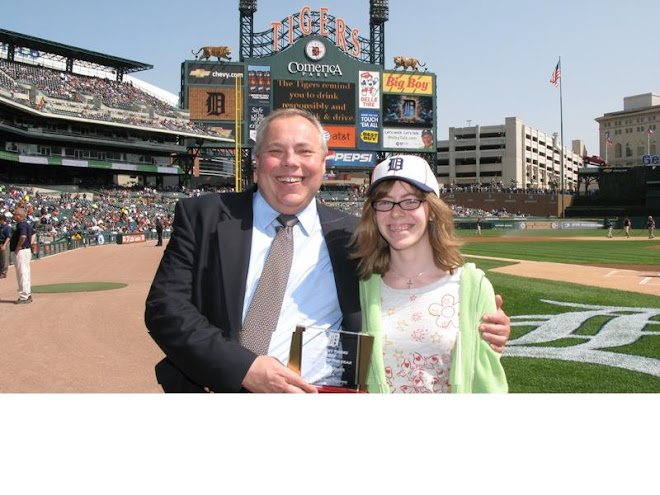
Inspired by Dave von Ebers, I have decided, what the Hell, to produce my own video blog, or, as the kids call them, Vlogs. I’ve upgraded the production values just a little as you will see, and I hope you enjoy it…
Inspired by Dave von Ebers, I have decided, what the Hell, to produce my own video blog, or, as the kids call them, Vlogs. I’ve upgraded the production values just a little as you will see, and I hope you enjoy it…
The most interesting thing I saw on the diamond last night was not Dontrelle Willis and the Detroit ‘pen one-hitting the Rangers (interesting though that was). It was, rather, the sight of Cleveland’s Kerry Wood blowing a 5-2 lead in the bottom of the 9th in Kansas City with two outs to get and the bases empty. The sequence off Wood went like this: homer, homer, 5-pitch walk, triple, sac fly, ball game. If Wood had held the lead, Detroit’s lead in the AL Central would be 2 games, not 1. It was the pitch count, again. Talk about dumb managing. Cliff Lee, the Cy Young Award winner last year—yes, that Cliff Lee—had a 5-2 lead and did not come out to pitch the 9th because, presumably, he’d thrown too many pitches (101). So on comes Wood to blow it. His ERA is now 8.31 and he’s allowed 4 home runs in 13 innings pitched. Lee, the guy they yanked, has allowed 3 homers in 62 innings. Just for the record.
At the other end of the end of the game spectrum would be Heath Bell of San Diego. I saw him come in to finish off the Giants last night and get a load of this: Bell is 10-10 in save situations and has allowed a grand total of zero earned runs this year. Right-handed hitters are hitting (or, to be precise, not hitting) .000 against Bell. They are oh-for-24 against him and that’s amazing.
So was Willis last night. A 1-hitter into the 7th and he only walked two and if he can regain his form the Tigers have a shot at the division. Hard to believe, but the win was the first for Dontrelle as a Tiger. We mentioned Kerry Woods’ ERA a moment ago. Willis last year had an ERA of 9.38. For the record, that placed him 635th in the Majors and dead last among pitchers with at least 24 innings pitched. He finished 293rd out of 316 pitchers if you only count those who pitched in the American League. Willis looked a little better than that guy on Tuesday night in ending Texas’ 7-game win streak, extending the Tigers win streak to four and giving Detroit 9-straight home wins over the Rangers.
On to hockey…
I was covering the Wings-Avalanche Western Conference Final in 1996 and on the flight to Denver after Detroit had lost Games 1&2 at home, I dug out my Stanley Cup Media Guide, (Detroit to Denver is a pretty long flight and I had some time on my hands), and I went through all the best-of-seven series’ in NHL history to see how teams fared after losing the first two games at home. I finished just as we were on final approach and it was then that I knew the Red Wings had sustained a fatal wound. The number was something a little over 95% -- the percentage of teams which had lost the first two games at home and had gone on to lose the series. Detroit, I knew then, had just a little more than 4% chance of coming back against Colorado. The Wings won the next night as they split the two games there to get the series back to Detroit, won at home to get the series back to Denver, but lost Game 6.
The 2009 edition of that same Media Guide, Total Stanley Cup, tells us that heading into the current playoff year, teams which have won Games 1&2 have gone on to win in the best-of-seven format 87.3% of the time. So, we can safely say that statistically at least, Detroit’s probability of winning this series against Chicago now stands at close to 90% after the overtime win over the Black Hawks Tuesday night—Detroit’s 4th straight OT playoff win against Chicago dating back to the 1995 Western Conference Final.
That said…
I can think off the top of my head of 3 occasions where the Wings won the first two game and did not win the best-of-seven.
The first (which I have only read about) was in the early 1940’s when Detroit became the first team in pro sports history to lose a best-of-seven series in which it led three games to none when Toronto came all the way back to beat them in a Stanley Cup Final series.
Another (which I listened to on the radio when the games were in Detroit because the home games weren’t on TV then—it’s true, you could go to a theatre to watch them otherwise it was Bruce Martyn and Budd Lynch on the radio—and watched on TV when the games were in Montreal) was the 1966 Stanley Cup Final in which Detroit won Game 1 and Game 2, in Montreal no less, before dropping four in a row to Canadien—I said it the way I wanted to, Canadien—three of them on home ice at the Olympia.
Yet another was in 1993 when the Wings beat up on the Maple Leafs good in the first two games, outscoring the Mapleo’s 12-5; dropping four of the next five including two in overtime at home, including Game 7.
So, this thing isn’t over. Not just yet.
There was no hockey Saturday, so, for the first time last fall, there was no Hockey Night in Canadia on the telly Saturday night. What to do, what to do…
The CBC knew just what to do. They re-aired “Canada-Russia ‘72”, a docu-drama about the historic 1972 8-game series between a team of Canadian-born NHL All-Stars (Phil and Tony Esposito, Bobby Clark, Ken Dryden et. al.) and the Soviet Red Army team. Everybody, I mean everybody, thought the Canadians – even without the Bobbys (Orr and Hull) – would win the Series, oh, about 8 games to none and by final scores in each game of about 15-0.
Instead, in Game 1 the Soviets came into the Montreal Forum and kicked the snot out of the Team Canada, 7-3 or something. I mean, they just killed ‘em. Nobody could believe it. Canada won the next game in Toronto but a tie and another loss followed. They were booed off the ice after that last game in Vancouver. And when Canada lost the first game in Moscow, blowing a 3-goal 3rd period lead no less, they had to win all three of the remaining games to win the series. How’d it turn out? Google it. Or just Google Paul Henderson.
I was in high school 1972 and since the games in Russia were being played during the afternoon our time, I remember my teachers sneaking out of class to watch on a TV in the teachers lounge down the hall. I didn’t care about that, I just wanted an update.
“Canada-Russia ‘72” is a terrific program. (It was nice how the CBC put up a disclaimer after every commercial break warning that the program contained “coarse language” -- which it did.) I’d recommend it to anyone not offended by coarse language.
It featured plenty of rock and roll period pieces from Canadian groups which meant a lot of the Guess Who. But also this one from the Five Man Electrical Band. You know them from the song “Signs” (long-hair freaky people need not apply…) but back in the day I thought this was a pretty good jam, so I’m glad they used in it in the show because I’d forgotten it. Do they still have “jams”? Just askin’.
Party on, Garth. Game 2, Wings and Black Hawks tonight!
Oh. My. God. This just in. WTF???
I thank God for Republicans. I thank God for Michael Steele.
Let’s stipulate the following right off the top: I love the Elias Sports Bureau. I know this might make you think I’m a geek, or a nerd, or even a geeky nerd, but I don’t even care. Where else are you going to get things like this:
When Toronto’s Roy Halladay beat the Yankees Tuesday, he improved to 16-5 (.762) lifetime against New York, the second-best winning percentage against the Yankees among all (opposing) pitchers with at least 20 decisions.
Do you know which pitcher has the best all-time winning percentage against the New York Yankees? This is the beauty part. According to Elias, it’s the most famous Yankee of them all: Babe Ruth! Ruth was 17-5 (.773) all-time against the Yankees. And if I have to tell you that before he became the greatest slugger of All Time in New York—it doesn’t matter that his records have been surpassed, he still pretty much invented the Home Run—that Babe Ruth was a member of the Boston Red Sox and one of the best pitchers in the American League, well, I’m sorry, but I don’t think we can see each other anymore.
Now, Elias also noted this week that Pittsburgh's 6-2 win in Washington matched the second-largest margin of victory by a road team in the seventh game of any NHL playoff series. The North Stars beat the Kings by five goals in a Game 7 in Los Angeles in 1968 (9-4), and the Oilers had a four-goal win at Colorado in 1998 (4-0).
Also, the Penguins opened the scoring in their Game 7 win over the Capitals with a pair of first-period goals eight seconds apart by Sidney Crosby (at 12:36) and Craig Adams (at 12:44). It was the fastest two goals by one team in any Game 7 in NHL playoff history. The previous record was 14 seconds by the Minnesota North Stars in their 9-4 win over the Kings in the seventh game of a first-round series in 1968 (second period: Andre Boudrias at 15:58, Dave Balon at 16:12). Those goals were hardly crucial in that game, as they increased Minnesota's lead from 6-2 to 8-2.
I thought that was pretty good stuff, too, but as I was thinking about it, I remembered something the Elias Sports Bureau had not included. The name of the goalie who gave up those 9 goals to the North Stars—including those goals 14 seconds apart—in the most lopsided 7th game home-ice loss ever. It may surprise you. It was one of the greatest goalies (if not the greatest) in NHL history: Terry Sawchuk.
That night he was shelled by the North Stars, Sawchuk—the goalie of record for Detroit in their Stanley Cup-winning seasons of 1952, ’54 and ’55—was less than a year removed from being the toast, once again, of the hockey world. (He was also, as it turned out, just over two years away from being dead.) A year earlier, in 1967, Sawchuk had come off the Maple Leafs bench to beat Montreal in 4-1 in Game 5 of the Stanley Final and 3-1 in Game 6 to win the Cup for Punch Imlach’s Toronto Maple Leafs. Sawchuk, stopping 40 of 41 Montreal shots, was the First Star in the clincher. It’s 42 years now and for the record, that’s still the last time Toronto won the Cup. A few weeks later, with the NHL expanding from six teams to twelve, Imlach left Sawchuk unprotected in the expansion draft and he became the first player selected by LA Kings owner Jack Kent Cooke. Sawchuk would last just one year in Los Angeles. That 9-4 loss at the Forum in Los Angles to the North Stars is a big part of the reason why.
Sawchuk’s coach in Los Angeles was his former teammate Red Kelly. “I was never so disappointed in Terry as I was that night,” he said. “I felt that he let me down and the team down. The loss wasn’t all his fault, but it was the big game and he missed it, really.”
Now here’s a question. Do you happen to know who Leonard “Red” Kelly is? If you don’t, you ought to. Kelly’s Detroit sweater, #4, should be hanging from the rafters at Joe Louis Arena right next to Gordie Howe’s #9, Ted Lindsay’s #7, Sawchuk’s #1 and the rest.
Kelly was to the Detroit Red Wings of the 1950’s what Nicklas Lidstrom is to the Red Wings of today. (A reporter from Stockholm once told me that we are all pronouncing “Lidstrom” name improperly. In Sweden, he said, it’s “LEED-strum”.) Anyway…
Kelly won four Stanley Cups with the Wings in the 50’s (1950, 1952, 1954, 1955), was on each of the Wings’ teams that won the NHL regular season title a still-record seven straight years, was the original winner of the Norris Trophy for Best Defenseman in 1954 and the runner-up two other times and was an eight-time All-Star—a record for a Detroit defenseman until that guy LEED-strum came along. The main thing you have to remember about Kelly as a Red Wing, though, are those four Stanley Cups.
Early in 1960, when a newspaper story out of Toronto suggested that the Wings had forced Kelly to play with a broken foot late in the 1959 season (they had) Jack Adams, the iron-fisted General Manager of the Red Wings, blew a gasket and in a fit of pique which can only be described as exquisite, traded Kelly to the Rangers. Kelly told Adams, and later NHL Commissioner Clarence Campbell, to take a hike, son. He’d quit before he’d report to New York. A few days later Adams shipped Kelly to Toronto for Marc Reaume. Kelly for Manon Rheaume might have been a better deal for Detroit.
The only reason Kelly-for-Reaume isn’t the worst trade in hockey history is that a couple of weeks after Sawchuk won that ’67 Cup for the Leafs, the Black Hawks decided Phil Esposito, Ken Hodge and Freddie Stanfield to Boston for Pit Martin, Gilles Marotte and Jack Norris sounded good like a good deal. The numbers say it wasn’t. Esposito scored 459 goals as a Bruin, Hodge 289 and Stanfield 135. Martin scored 243 times for Chicago and Marotte scored10. Norris was a goalie who appeared in 10 games for the Black Hawks. So, Chicago traded 883 goals to Boston and got back 253. This is not good value.
Neither was Kelly-for-Reaume. The guy for whom Adams traded his LEED-strum played 47 undistinguished games for Detroit and was down in the minors in less than a year.
Kelly, still wearing his # 4, only wearing it for the Leafs now, played 8 more years in the NHL and won 4 more Stanley Cups, giving him 8 for his career. You could look this up yourself or Elias could tell you, but of the 1,134 players who have put their name on the Stanley Cup, only 5 have had theirs etched upon it more often than Red Kelly.
Two of Kelly’s post-trade Cup wins came over the team that traded him away, the Red Wings. Kelly grew up in southern Ontario in a small town not too far from Detroit and his dad would come and see him play at the Olympia when Toronto was in town. One night he saw Jack Adams there and before Adams could scurry away he went up to him and said, “The Stanley Cup just seems to follow that boy around, doesn’t it?”
Here’s the thing. There’s another boy out there who the Cup seems to “follow around.” His name is Scotty Bowman. He’s got nine Cups as a coach (more than any other coach, ever) and two more as an executive for a total of eleven. Five of those Cup wins came with the Detroit organization. He left the Wings in the past off-season. He’s with Chicago now.
Nobody gives the Black Hawks much of a shot against the Red Wings in the Western Conference Final, but I worry when I think about things like this. I could stop reading items from the Elias Sports Bureau, but some of these things I think up on my own and there is not much that can be done about that.
A shoutout to the Red Sox this morning which scored 12 runs before making an out in the 6th inning last night to overcome a 2-1 Indians lead at the Fed and to set an all-time AL record for Most Runs Scored Before A Batter Made an Out, and to tie some NL team which also put up a dozen before a single batter had been outed – back in 18-freaking-83 which I’m not sure even counts to begin with.
Hon Men to Andy Pettite for giving up 4 homrs in a game for the fist time in his career (432 starts/442 appearances) and to Mariano Rivera for giving up homers back-to-back for the first time in his career (863 appearances)and to Yankee Stadium for surrendering 47 homers in only 13 games. The Yankees and their new yard are going to make a travesty of the game at this rate.
LA w/out ManRam? They looked okay at first, batting around to score 6 in the botom of the first against the Nationals, only to later blow that 6-0 lead and lose for the first time at home this season, 11-9 to DC. Ended is LA's MLB-record streak of 13 straight home wins to start a season.
Here's the deal: I heard from the editor and they liked it just fine. If it's been posted yet I haven't seen it, so, since I know everyone has been waiting with baited breath, here's what I wrote for that new website I'm "trying out" for...
Around the League with Rich Kincaide
“The one constant through all the years, Ray, has been baseball. America has rolled by like an army of steamrollers. It has been erased like a blackboard, rebuilt and erased again. But baseball has marked the time. This field, this game: it's a part of our past, Ray. It reminds us of all that once was good and it could be again…”
“Terence Mann” (played by James Earl Jones) from Field of Dreams
Nice speech, James Earl. It turns out not to have been true, but nice speech nonetheless.
The game, “the constant through all the years”, has changed.
Last week, Tigers’ starter Edwin Jackson did not venture out of the dugout for the 7th inning at Comerica Park in spite of the fact that he was locked in the very definition of a pitchers duel against New York: a scoreless tie through six. (The Detroit bullpen promptly made baseball history in the top of the 7th, allowing the Yankees to score 10 runs—although to be fair only 7 of them were earned—as Detroit became the first team in American League history to allow at least ten runs in another teams at-bat in a game in which the score was 0-0 in the 7th inning or later. The Tigers, as you may have heard, lost.)
Why did Jackson get the hook? Simple. He’d pitched 117 pitches and when it comes to heaving the spherical object from 60’ 6” these days, that statistic, the Pitch Count, is the only stat that counts. It’s not just Detroit Manager Jim Leyland, either. It’s the game. Baseball has changed.
Last Friday night, Jake Peavy of the Padres was pulled after 8 innings in the midst of a two-hit shutout. He’d thrown101 pitches, you see. Peavy’s mound foe, LA’s Clayton Kershaw, lasted seven shutout innings. He’d allowed only four hits and had yet to offer up his 100th delivery of the night. On Sunday in San Francisco, it mattered not that the Giants Barry Zito was twirling a gem: a two-hit shutout through 7. Zito, having lobbed it up there 101 times just like Peavy had, did not come out to start the 8th. The opposing pitcher, Colorado’s Jason Hammel, exactly as Detroit’s Jackson had been against the Yankees five days earlier, was pulled after six in 0-0 ballgame. Hammel’s pitch count? 79.
I’m got to tell you something. I’ve known Major League pitchers who wouldn’t have given it a second thought if they’d thrown 179 pitches through six as long as the other team was goose-egged. They’d be staying in the ballgame.
Seriously, can you imagine what would have happened if Jack Morris had a shutout going through 6 and Sparkly Anderson informed him that he would not be answering the bell for the 7th inning? I’ll tell you what: A fistfight in the dugout.
In 1963, Juan Marichal threw a 16-inning complete game. Do you suppose he did that in 100 pitches or less? If they even kept a Pitch Count back then and I don’t think they did (and if they did I can’t find it) I read somewhere that Marichal said he was certain he’d thrown at least 250 pitches in that game and probably more. His opponent that day, Warren Spahn, only went 15-and-a-third innings. That’s because some guy named Willie Mays took him deep in the bottom of the 16th inning for the game’s only run in a 1-0 San Francisco win. I think it’s safe to say Spahn threw slightly more than 100 pitches, also.
Marichal, whose 1963 line included 25 wins and 18 complete games, pitched for 15 years in the Majors; won more games (191) than any other pitcher in the 1960’s and is in the Hall of Fame. Spahn, who was 42 the day he went 15-and-a-third in what has to be one of the hardest-luck losses ever, only won 23 games that season. Perhaps it occurred to him at some point that if the result of that one game had been reversed he and Marichal would have each won 24? In any event, Spahn retired as the winningest left-handed pitcher in big-league history with a career win total of 363. He’s in the Hall, too. Of course.
Now, 46 springs later, if you want see a guy to finish what he started, you have to look to Zach Greinke of the Royals, he of the 6-0 record and the 0.40 ERA. (Really? A 0.40 ERA when you are one-third of an inning off the league lead in innings pitched? 2 earned runs allowed and it’s May?) Through Tuesday, 85 pitchers had started at least one of the 186 games played this season in the American League. Only 5 of those186 games (2.7%) have featured a 9-inning complete game and only 3 pitchers have done it. Greinke himself has thrown 3. His highest pitch count in any game this season is111, meaning he seems to be the only pitcher out there who knows that if you want to be there a the end one must do it with both dispatch and efficiency.
Finally, somebody asked me about the Wings/Ducks series and I told them the thing that worried me the most about Anaheim was not that the Ducks had outplayed the Sharks in becoming the eighth 8th seed to knock off a #1 seed since San Jose became the first team to do it against Detroit in 1994 (they did), nor was it that their goaltender stopped 220 of 230 Sharks shots (95.7%), nor was it that next to Detroit the Ducks had more players on their roster (12) who had already won a Stanley Cup than any other team in the playoffs. No, it was none of those things. What scared me the most about the Ducks was the name of the arena where Anaheim plays their home games. I heard somebody who should know better call it “The Pond” the other day on the radio. Sorry, it’s not. It’s called the Honda Center. With the way things are going in Detroit and with the way things are going over at General Motors right now, does that strike anybody else besides me as, well, ominous? Could it perhaps be unlucky? Did anybody besides me stay up to see the end of Game 3 there? Would you say what will forevermore be known in Detroit as “The Washout” qualifies as unlucky?
I heard another radio guy a couple of days ago refer to the Ducks goalie as “Miller”. Uh, sorry, it’s Hiller. I’m pretty sure you spell it G-I-G-U-E-R-E.